All Night, Wrestling

Some nights I am Jacob, wrestling with God. 

On the edge of fear and despair, at the end of himself, alone, desperate, he realizes the shadowy figure he is wrestling with is God Himself. I feel Jacob’s desperation: I won’t let you go unless you bless me! 

Such a strange story, yet I peer into it and see my reflection. I lay awake for hours, blood raging, pounding on the chest of the One who has the power to act, but isn’t. Why aren’t you doing something? Why aren’t you changing this? How many prayers do I have to pray before something happens? 

Enough is enough. A God with power wouldn’t allow this injustice to continue. A God who cares would take this burden off my friend. A God who sees would heal that wound in my child.

The unanswered prayers linger large in the room, their weight keeping me awake. I threaten God: Answer! If you don’t come through on this one, it will weaken my faith. And it will be your fault. 

Somebody on Twitter wrote something like, “Am I depressed or just having an appropriate response to all the horrible things happening in the world?” If I knew the person who tweeted that, I would give her a fist bump. If I was the sort of person who gave fist bumps. 

I watch those tossing their faith over their shoulder and think about how easy that seems. What if I chose not to believe anymore? To give up on prayers, to take the darkness at face value? I gingerly pick up the idea, hold it at arm’s length, examine it from all angles. What is the point of this wrestling? Wouldn’t it be easier just to give in, walk away? 

Metamorphosis

I’m standing in a dusty marketplace in Dar es Salaam, surrounded by shanties selling piles of mangos, bicycle parts, and bright plastic tubs, buses interweaving. The sky turns dark, ominous. Foreboding hangs in the air, yet I am thrilled by the storm. Then, a crushing, permeating sense of loss. The rain falls and mixes with my tears. I wake up, and my face is wet. Loss lingers, dredged up from my subconscious.

Memories fall on me at the oddest times. I hear the phrase That’s why come out of my mouth and my mind flicks to Lucy. Ndiyo maana, she says, followed by That’s why in her thickly accented English. We’re studying Swahili at my beautiful mninga wood kitchen table, which Gil and I commissioned from the Lebanese guy downtown, the one who copies his furniture from Ikea catalogs. Behind me on the wall is the large world map, and on the opposite wall is the little cabinet holding the dishes gifted to me by the 6th-grade class I taught in 2006. I can hear the buzzing of the saws from the carpenter shop next door and the occasional crowing of a rooster. Lucy laughs her big laugh (Lucy is always laughing) and asks me to repeat after her: Ndiyo maana.

Lucy writes to me occasionally on WhatsApp, and I feel my Swahili slipping out of my brain. Sometimes I think I should start learning Spanish since it would be useful in Southern California, but I fear it would take up the spaces that Swahili fills. What if I forget Ndiyo maana

Trusting God With What You Leave Behind

A few weeks after we arrived in Tanzania, Gil and I heard breaking glass in the middle of the night. Imagining the worst, we rushed downstairs to discover that one of our pictures had fallen off the wall. No big deal.

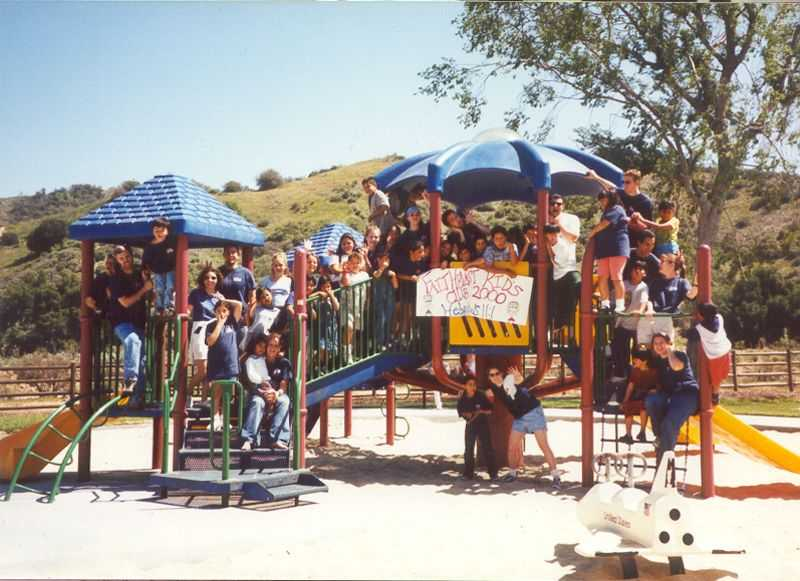
Except that the picture represented something that was a big deal. In it, Gil and I stood smiling on a park playground with a half dozen other adults and about 30 kids. We all wore navy blue Faithblast! shirts. This was a photo of the weekly kids’ club that Gil and I had started in Southern California. 

Gil and I barely knew each other when we started FaithBlast, and it’s how we fell in love. The ministry was our baby. We nurtured it for four years, and it blossomed into further neighborhood outreach. Our story was inextricably linked with that neighborhood, that playground, those kids. 

Knowing we were heading overseas, Gil and I had fervently searched for someone to take over the ministry when we were gone. But there was no one. When we left, the FaithBlast ended.

So when the picture fell off the wall and the glass smashed into pieces, it felt eerily symbolic. Fresh tears came. Why had we left a thriving ministry that was so dear to us to come to this unfamiliar and uncomfortable place where we had to start from scratch all over again? 

Selling Our Souls to Soccer?

Josiah came home to us at nine months old and found the ping pong balls on the second day. They were the perfect size for his tiny fists and he crawled around the house with one in each hand, clicking on the tile floors. 

His first word was daddy and his second word was ball and I’m not bitter about that at all of course.

All his favorite toys centered around soccer. On Sundays after church, we ate at P-Square and while we waited for our rice and beans and mishkaki (P-Square had the best mishkaki), he and his sisters would hunt around the plastic tables for bottle caps. Soon he had enough so that each kind was a soccer team – like, Fanta was Manchester United and Sprite was Liverpool. Gil made him a soccer field out of green pressboard and Josiah spent hours playing bottlecap soccer, arranging his “players” in perfect formation. 

Every year for his birthday, the only gift he wanted was the new version of the FIFA video game. So every fall, we figured out a way for somebody to bring us FIFA 2014 or 2015 or 2016 out to Tanzania. His parties were soccer themed for six years in a row. 

He mastered a diving header at three and a bicycle kick at four. He played soccer before school, at recess, and after school and usually came home with his lunch uneaten because he played then too. When I nagged him about eating lunch, he asked me to make him something he could shove down his throat in 30 seconds. 

In Tanzania, I loved that Josiah loved soccer and I loved watching him play. He joined the HOPAC team and had a couple of practices and a game each week. Maybe twice a year, he had a tournament on a Saturday. Often, Gil was his coach. On Sunday evenings, families would informally gather at HOPAC and play together – all ages. Soccer almost always happened at HOPAC so it flowed easily into our lives. 

Two years ago, we moved to America, and I started hating soccer. Josiah was quickly recruited for an AYSO club team, and we said yes because during the pandemic, we were eager to help him make connections. And thus, the full force of what it means to have a kid play club soccer crashed down on me, with evening practices and games almost every weekend – year-round.

I threw several little hissy fits last year. I seethed against the hurried family dinners and the lack of free time on weekends. I mourned our busyness and inability to spend more time in ministry. But then I looked around and other families didn’t seem fazed by this. Driving an hour to a tournament every Saturday was apparently normal life for American parents. I experienced serious culture shock. 

Gil and I have never had aspirations for our kids to go far in sports. We don’t have lofty goals for college; we drive past the community college five minutes from our house and cheerfully announce, “Hey kids, wave hello to your future college!” I rail against this American culture that tells me I must push my children to reach their potential in every area, that success in school and sports or arts is the ultimate goal of parenting. 

Josiah always said he wanted to be a professional soccer player when he grew up. And I would always smile condescendingly and say, “That’s a nice dream, Buddy, but it’s not going to happen. Choose something else.” This was usually followed by, “Get off your backside and do your homework.”

Unfortunately for me, this summer the coach of an elite team invited Josiah to be a starter on his team. He told us that Josiah could likely play for a Division I college. And possibly become a professional player.

My Body, My Choice: The Argument of Autonomy

My mom always told me that my first full sentence was (with all the attitude a two-year-old can muster), “I can do it myself!”

You could say that the rest of my life has been one big lesson in precisely the opposite: I cannot, actually, do it myself.

Sometimes I can’t even keep a grip on reality. There are times in extreme anxiety when I’ve told Gil or a friend, “When I feel this way, you need to tell me this truth.” Without other people, I wonder if I would even be sane.

Children raised with minimal human interaction are underdeveloped mentally, socially, emotionally. Our very existence is dependent on others. 

So isn’t it ironic that in America, we idolize autonomy? Americans love choices. Whether it’s frozen yogurt toppings, owning a gun, getting a vaccine, wearing a mask, or determining your gender, we champion individual decisions. Follow your heart. You be you. Your body, your choice. 

Independence is such a part of the air we breathe that we might not realize that it’s not a universal value. 

Did you know that when compared with other countries, the “Individualism” score for the United States ranks the highest in the entire world? Autonomy is not a universal value. With few exceptions, every country in the world values connection to family and society more than we do.

I asked a friend from Europe what he found unexpected about American culture. He said, “Going into a sandwich shop and choosing your own toppings.” In Europe, they choose the toppings for you. But here, you can have it your way. 

In America, we hand babies a spoon at six months old. We praise the three-year-old who puts on his shoes. “You’re such a big girl!” is the ultimate toddler compliment. But I’ve met Tanzanian mamas who still breastfeed at three and Indian mamas who are still spoon-feeding their four-year-olds. They are in no hurry for their children to gain independence.

Autonomy is not a universal value. So should we step back and evaluate it?

Page 16 of 233

Powered by WordPress & Theme by Anders Norén

Verified by MonsterInsights